
Famous Landmarks Quiz
By James Haddon · Updated September 2026
Researched and written with the help of AI tools and reviewed by James Haddon for accuracy.
The Great Pyramid of Giza was completed around 2560 BCE and remained the tallest human-made structure on Earth for 3,800 years — until Lincoln Cathedral in England surpassed it around 1311 CE. For nearly four millennia, no human technology exceeded what workers built in ancient Egypt using stone, rope, sledges, and an organization of labor we still don't fully understand. Modern engineering analyses of the Great Pyramid routinely conclude that we could not replicate it with comparable constraints.
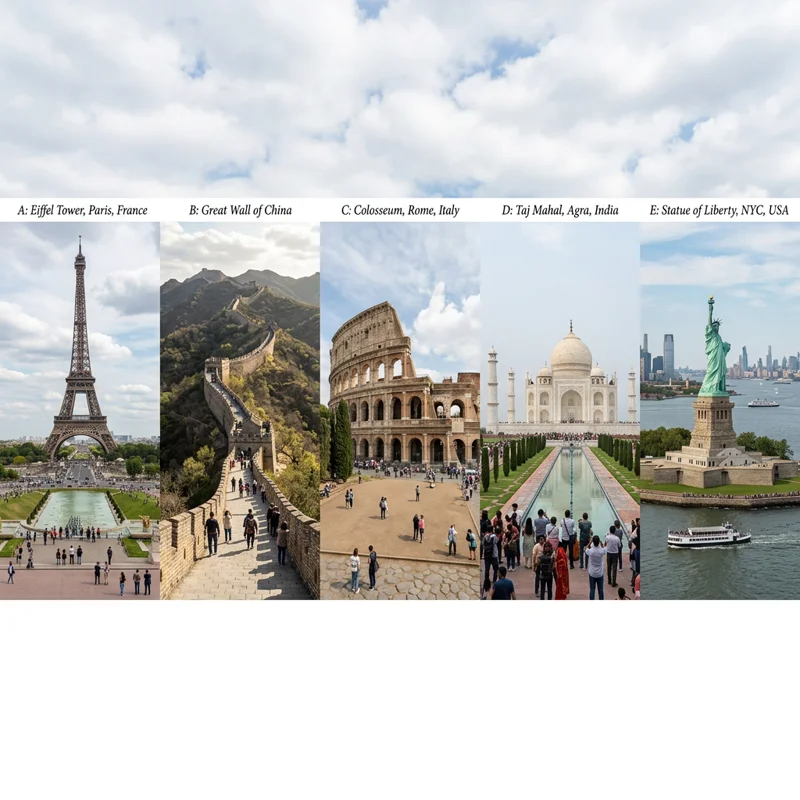
What makes great landmarks enduring is not just their age. It's the clarity of the intention behind them and the backstories that reveal it. The Eiffel Tower was built as a temporary structure for the 1889 World's Fair and was scheduled for demolition in 1909 — it survived because it doubled as a radio transmission tower. The Sydney Opera House was designed by a Danish architect, Jørn Utzon, who had never visited Australia when he submitted his competition entry. Angkor Wat, the world's largest religious structure, was lost to the outside world for centuries before being brought to international attention in 1860.
Of the original Seven Wonders of the Ancient World — the Great Pyramid, the Hanging Gardens of Babylon, the Statue of Zeus at Olympia, the Temple of Artemis at Ephesus, the Mausoleum at Halicarnassus, the Colossus of Rhodes, and the Lighthouse of Alexandria — only the Great Pyramid still stands. The rest were destroyed by earthquakes, fires, and raids over the centuries following their construction.
Twelve questions on the world's most famous landmarks. How many do you actually know?
Key Takeaways
- •The Great Wall of China stretches approximately 21,196 km (13,171 miles) in total — though much of the wall has eroded. The popular claim that it's visible from space is false.
- •The Eiffel Tower was originally built as a temporary structure for the 1889 World's Fair and was planned for demolition in 1909. It was saved because it served as a radio transmission tower.
- •The Colosseum in Rome could hold between 50,000 and 80,000 spectators and featured a retractable awning called the velarium, operated by Roman sailors.
- •Machu Picchu was built by the Inca Empire in the 15th century and was largely unknown to the outside world until Hiram Bingham III brought it to international attention in 1911.
- •The Statue of Liberty was a gift from France to the United States in 1886. The copper skin was originally shiny reddish-brown and oxidized to its current green patina over decades.
Decisive Acts: What Every Great Landmark Has in Common
Great landmarks share a quality beyond age or size: they represent a decisive act of human will. The Pyramids of Giza reflect a civilization's absolute commitment to the afterlife. The Great Wall reflects a civilization's absolute commitment to security. The Sydney Opera House reflects an era's commitment to cultural ambition. When we visit or study these structures, we're touching the decisions of other humans who chose to make something that would outlast them — and did.
Fascinating Landmark Facts
The Leaning Tower of Pisa actually leans because of soft soil on one side during construction — it began tilting almost immediately.
The Great Sphinx of Giza has no nose. It was likely deliberately knocked off — possibly by a religious figure who objected to idol worship.
Stonehenge's stones were transported from Wales, approximately 200 miles away, using methods that remain partially debated.
The Taj Mahal changes color throughout the day — pink in the morning, white in the afternoon, and golden in the moonlight.
Frequently Asked Questions
What is the most visited landmark in the world? The Eiffel Tower is the most visited paid monument in the world (approximately 7 million visitors per year). However, the Great Wall of China (free in most sections) receives approximately 10 million visitors per year. Times Square in New York City (technically a public intersection) sees approximately 50 million visitors annually, though it requires no admission.
What are the Seven Wonders of the Ancient World? The original Seven Wonders of the Ancient World were: the Great Pyramid of Giza (the only one still standing), the Hanging Gardens of Babylon, the Statue of Zeus at Olympia, the Temple of Artemis at Ephesus, the Mausoleum at Halicarnassus, the Colossus of Rhodes, and the Lighthouse of Alexandria. All except the Great Pyramid were destroyed.
What is the tallest building in the world? As of 2024, the Burj Khalifa in Dubai remains the world's tallest building at 828 meters (2,717 feet). It opened in 2010. The Jeddah Tower (Saudi Arabia), currently under construction, is designed to exceed 1 kilometer when completed.