
What Animal Are You?
By James Haddon · Updated July 2026
Researched and written with the help of AI tools and reviewed by James Haddon for accuracy.
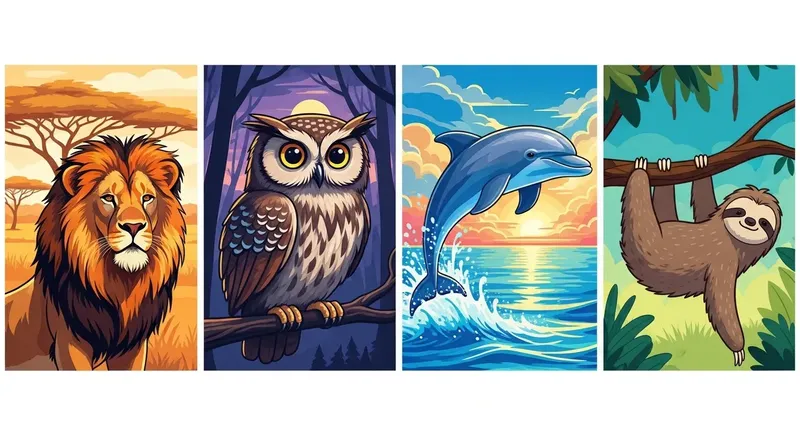
The DISC personality model — first outlined by psychologist William Moulton Marston in his 1928 book Emotions of Normal People — maps personality into four quadrants: Dominance, Influence, Steadiness, and Conscientiousness. Animal personality systems borrow those same four dimensions but replace the labels with something more vivid and memorable.
Corporate trainers and coaches have used animal archetypes to teach personality frameworks since the 1980s, precisely because people remember 'I'm a Lion' long after they've forgotten their DISC score. This quiz maps those four quadrants to Lion, Owl, Dolphin, and Sloth.
Twelve questions about how you handle pressure, make decisions, and work with others will match you to the animal whose natural style mirrors yours. No animal is better than another. Tap "Start Quiz" to find out which one you are.
Read the article
How to Actually Use Your Personality Quiz Results (Without Overthinking Them)
You got your result. Now what? A practical guide to making sense of personality quiz outcomes — and what to do when they don't match how you see yourself.
Read the article →Read the article
What Animal Are You? The Psychology of Spirit Animals and Personality
Spirit animals, animal archetypes, and personality quizzes have merged into a cultural phenomenon. Here's what psychology actually says about why we identify with animals — and what your favorite animal might reveal.
Read the article →Key Takeaways
- •Animal personality archetypes appear in ancient Egyptian, Chinese, Native American, and medieval European traditions.
- •Modern psychology maps animal archetypes to the Big Five — Lion = high extraversion + conscientiousness; Owl = high openness + low extraversion.
- •No personality type is superior — each has distinct strengths suited to different roles and environments.
- •The four archetypes in this quiz (Lion, Owl, Dolphin, Sloth) map closely to the four quadrants of the DISC personality model.
- •Most people identify strongly with one primary type while sharing meaningful traits with a secondary one.
How this quiz works
Twelve questions ask how you handle pressure, make decisions, socialise, and respond when things go wrong. Each question maps to one of four personality orientations borrowed from the DISC model — Dominance (Lion), Conscientiousness (Owl), Influence (Dolphin), Steadiness (Sloth) — and your most-chosen orientation determines your result.
Answer what you'd actually do rather than what sounds best. Most people have a clear primary type with meaningful traits from a secondary one — the result will show which combination fits you most accurately.
The psychology behind animal archetypes
Animal personality archetypes have been used throughout human history — from ancient totems to modern corporate training programs. They work because they're vivid, concrete, and emotionally resonant. Saying someone is 'an owl' communicates a cluster of traits — thoughtful, observant, unhurried, precise — far more efficiently than listing adjectives.
Psychologists refer to this as the 'prototype effect': humans naturally think about categories through their most representative examples. Animals work particularly well as personality prototypes because we have intuitive, culturally shared understandings of their behaviors and demeanors, which makes the trait mapping feel immediately recognizable.
The four archetypes in this quiz — Lion, Owl, Dolphin, Sloth — map closely to the four quadrants of the DISC personality model (Dominance, Influence, Steadiness, Conscientiousness) and to the four temperaments of classical psychology (Choleric, Sanguine, Phlegmatic, Melancholic).
The four animal personalities in depth
The Lion maps to high Dominance in the DISC model — decisive, results-oriented, competitive, and comfortable with conflict and authority. Lions are natural leaders in high-stakes situations. Their shadow side is impatience and a tendency to steamroll more deliberate colleagues.
The Owl maps to high Conscientiousness — analytical, detail-oriented, quality-focused, and systematic. Owls research thoroughly before committing and produce precise, well-reasoned output. Their shadow side is analysis paralysis and difficulty making decisions under uncertainty.
The Dolphin maps to high Influence — sociable, enthusiastic, optimistic, and energized by human connection. Dolphins build consensus, maintain team morale, and excel in roles requiring persuasion and collaboration. Their shadow side is avoiding difficult truths and over-prioritizing harmony at the expense of necessary confrontation.
The Sloth maps to high Steadiness — patient, dependable, calm under pressure, and deeply loyal. Sloths provide consistent, reliable performance and create stable foundations for teams. Their shadow side is resistance to change and difficulty asserting preferences or disagreeing with others.
- •Lion — bold, decisive, competitive; thrives under pressure and in leadership roles
- •Owl — analytical, precise, thorough; thrives in research, planning, and quality assurance
- •Dolphin — social, enthusiastic, empathetic; thrives in relationship-building and team roles
- •Sloth — patient, reliable, calm; thrives in supportive and stability-oriented roles
Animal archetypes across world cultures
Animal symbolism has shaped human culture for millennia. Ancient Egyptians venerated the owl for wisdom (associated with the goddess Neith) and the lion for royal power (the Sphinx being the most famous example). Chinese astrology assigns one of 12 animals to each birth year, with each animal carrying a specific personality profile used in matchmaking, career planning, and cultural interpretation.
Indigenous cultures across North America, Australia, and Siberia use animal totems to describe clan identity, personal calling, and spiritual relationship with the natural world. The specific animals and their meanings vary significantly by tradition — the raven is a trickster and creator figure in Pacific Northwest traditions, a harbinger of death in European folklore, and a symbol of wisdom in Norse mythology.
Modern personality frameworks like DISC, the Enneagram, and Myers-Briggs have all been mapped to animal archetypes because they make abstract trait dimensions vivid and emotionally memorable. Corporate trainers favor animal models because participants remember 'I'm a Lion' long after they forget their DISC score.
What your animal result really means
Your result reflects your dominant style — the default mode you fall into when you're most comfortable and operating at your best. But most people are a blend of multiple types, with a primary and a secondary.
Context matters too. You might be a Dolphin in social settings and an Owl at work — and that's not inconsistency, it's appropriate flexibility. The quiz identifies your strongest pull across the questions, not a fixed identity.
The most useful way to apply your result is to identify the complementary types around you. Lions benefit enormously from Owls who slow them down with analysis. Dolphins need Sloths to ground them in steady execution. Understanding the four types helps you appreciate colleagues whose style feels frustrating — often because they're balancing your blind spots.
Frequently asked questions about animal personality types
Is this quiz scientifically validated? Animal personality quizzes are not clinically validated psychological instruments. They're built on models (like DISC) that have some empirical support but significant limitations — particularly around test-retest reliability and cultural generalizability. Use your result as a fun self-reflection prompt, not a definitive psychological label.
Can your animal type change? Yes, especially with major life transitions. A naturally Sloth-type person who moves into a management role often develops Lion behaviors out of necessity. Over long time spans, Big Five personality traits show meaningful change — particularly conscientiousness (which tends to increase with age) and neuroticism (which tends to decrease).
What if I'm split between two animals? That's common and healthy. Most people have a primary type and a secondary type. If you're between Dolphin and Lion, you likely have high extraversion with variable levels of warmth and assertiveness depending on context — a 'Driver-Expressive' blend in social style terms.
Do these types apply across cultures? The four broad dimensions (dominant, influencing, steady, conscientious) appear consistently across cultures in personality research. However, the cultural value placed on each type varies — high-Dominance (Lion) behavior is more rewarded in individualist cultures (US, Western Europe) than in high-context collectivist cultures (Japan, South Korea).