
World Capitals Expert Quiz
By James Haddon · Updated February 2025
Researched and written with the help of AI tools and reviewed by James Haddon for accuracy.
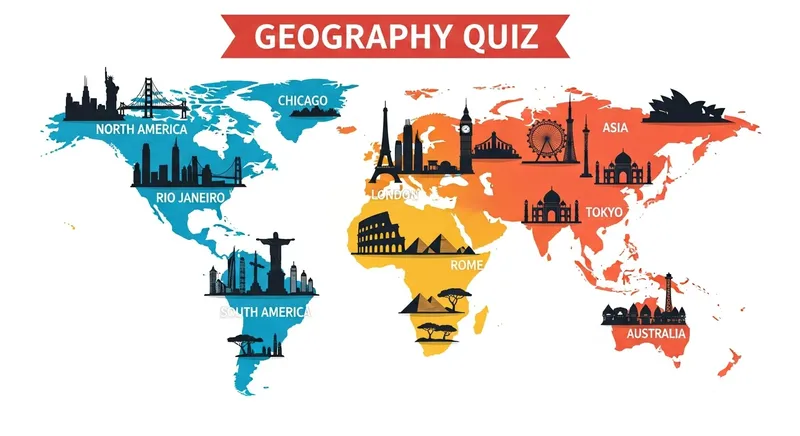
Capital cities are political decisions as much as geographic ones. Brazil built Brasília from scratch in 1960 to shift economic development away from the coast. Australia chose Canberra specifically because neither Sydney nor Melbourne would accept the other as capital. Washington D.C. was carved from disputed territory between Virginia and Maryland so no existing state gained an unfair advantage.
This quiz covers 14 capital cities spanning Asia, Europe, the Americas, and Africa. Each answer includes a brief explanation, so you'll learn something even when you miss one.
How many can you name? Tap "Start Quiz" and find out.
Key Takeaways
- •Many countries have capitals that are NOT their largest city — Canberra (not Sydney), Ottawa (not Toronto), and Brasília (not Rio) are classic examples.
- •The world has 195 sovereign countries, each with at least one official capital city.
- •Some countries have multiple capitals serving different government functions — South Africa has three.
- •Capital cities are often purpose-built to resolve geographic or political disputes between rival cities.
- •Regular exposure to international news is one of the fastest ways to reinforce geography knowledge.
Why geography knowledge matters
Knowing world capitals isn't just about trivia — it anchors your understanding of global politics, diplomacy, and culture. When you read that negotiations are happening 'in Berlin' or 'in Nairobi', knowing where those cities sit geographically and politically gives the news meaningful context.
Geography also builds mental maps that make international information stick. Studies on spatial cognition find that people who regularly engage with world geography show better retention of geopolitical information overall — the map provides the scaffold onto which historical and political knowledge attaches.
What makes a capital city?
A capital city is the seat of a country's government — typically where the legislature, executive, and key ministries are based. But the designation is rarely just about geography. Many capitals were chosen, or even built from scratch, to signal political unity, resolve regional rivalries, or project national ambition.
Brazil moved its capital from Rio de Janeiro to the purpose-built Brasília in 1960 to drive development away from the coastal southeast. Australia chose Canberra as a compromise because neither Sydney nor Melbourne would accept the other as capital. Washington D.C. was carved out of land between Virginia and Maryland for exactly the same reason. Kazakhstan moved its capital from Almaty to Astana (now Nur-Sultan) in 1997 partly to assert sovereignty over its ethnically mixed northern steppe regions.
Some countries have multiple capitals serving different government functions. South Africa has three: Pretoria (executive), Cape Town (legislative), and Bloemfontein (judicial) — a historical legacy of the 1910 Union of South Africa negotiations.
The world's most surprising capitals
Some capitals catch even geography enthusiasts off guard. Naypyidaw — not Yangon — is the capital of Myanmar, having been built almost overnight in 2005 as a new purpose-built city. Sri Lanka's legislative capital is Sri Jayawardenepura Kotte, not the globally recognized city of Colombo. Bolivia's constitutional capital is Sucre, not La Paz (which is the seat of government). The Netherlands' seat of government is The Hague, not the capital Amsterdam.
Understanding that the largest city is often not the capital is one of the most transferable geography facts. Sydney (not Canberra), Toronto (not Ottawa), São Paulo (not Brasília), Shanghai (not Beijing), Mumbai (not New Delhi) — the pattern repeats across every major geography quiz category.
Strategies for learning world capitals
The most effective method is spaced repetition — reviewing capitals at increasing intervals as you learn them. Apps like Anki or Duolingo geography sets use this method automatically.
Group capitals by region and tackle one continent at a time rather than trying to memorize them globally. Europe and Asia have the most capitals and the most quiz-trick ambiguities. Africa is the most common weak spot for quiz contestants because its 54 countries include many capitals that don't appear in mainstream media.
Connecting capitals to real events dramatically improves retention. If you read about a summit in Addis Ababa, a disaster in Kathmandu, or an election in Nairobi, you've passively reinforced three African and Asian capitals through contextual memory.
- •Group capitals by continent — learn one region at a time
- •Use spaced repetition flashcard apps (Anki, Duolingo) to drill high-frequency capitals
- •Follow international news — capitals appear constantly in context
- •Remember: the largest city is often not the capital
- •Learn the 'trick' capitals first: Canberra, Ottawa, Brasília, Pretoria, Islamabad
Frequently asked questions about world capitals
How many capitals are there in the world? There are 195 sovereign countries recognized by the UN, each with at least one capital, plus some countries with multiple capitals for different government functions. That's roughly 195–200 capital cities to know.
Which capital is the highest in the world? La Paz, Bolivia (seat of government, though Sucre is the constitutional capital) sits at 3,640 meters above sea level, making it the world's highest-elevation seat of government. Quito, Ecuador (2,850m) and Kathmandu, Nepal (1,400m) are other high-elevation capitals.
Which is the newest capital? Naypyidaw (Myanmar, 2005) and Nur-Sultan (Kazakhstan, 1997) are among the newest purpose-built capitals. Dodoma replaced Dar es Salaam as Tanzania's capital in 1996, though Dar es Salaam remains the commercial hub.
Why does Australia have Canberra instead of Sydney or Melbourne? The Australian Constitution required a new capital be built in New South Wales, at least 100 miles from Sydney. The site of Canberra was selected in 1908 as a compromise after Sydney and Melbourne both lobbied to become capital. Construction began in 1913.